
What European Decision-Makers Are Really Talking About on Bluesky
20 de April de 2026A one-month snapshot of what MEPs and Commissioners are posting — and why it matters.
For years, X (formerly Twitter) was the undisputed home of European political conversation. MEPs announced votes there. Commissioners responded to crises there. Journalists monitored it obsessively. But the platform’s landscape has shifted considerably, and so have the habits of the people who shape EU policy.
Between 27 March and 28 April 2026, Disclosing Europe tracked all posts published on both X and Bluesky by Members of the European Parliament and European Commissioners. The numbers tell a clear story — but the nuance tells a more interesting one.
The raw numbers
On X, 406 unique MEPs and Commissioners published a combined 8,668 posts over the month. On Bluesky, 283 authors generated 2,336 posts. X still leads in volume — roughly 3.7 times more posts and a wider active user base. That gap is real and shouldn’t be ignored.
But consider what 2,336 posts from 283 elected and appointed officials actually represents. That’s not a niche experiment. That’s a substantial, active, and growing community of political actors choosing a different channel — and choosing it deliberately.

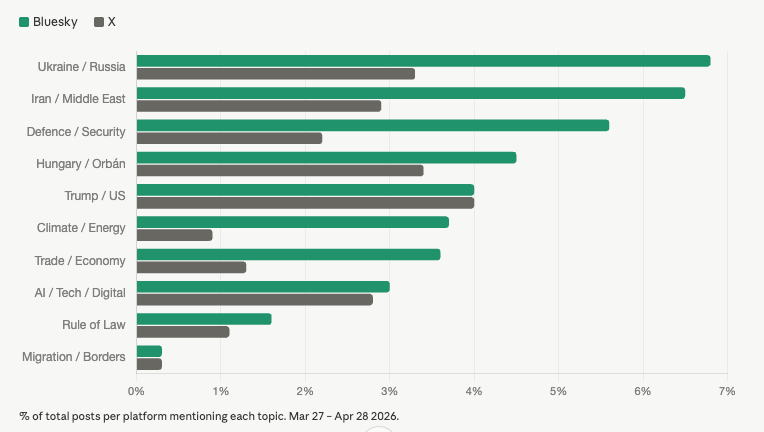
Is Bluesky’s presence significant?
Yes — and significantly underestimated by those who still treat X as the only game in town. Having 283 MEPs and Commissioners actively posting on Bluesky means that roughly a third of the entire Parliament and Commission is generating public political content on a platform that most monitoring tools still ignore entirely. Issues raised there, positions announced there, and debates happening there are flying under the radar of traditional political intelligence.
That’s a blind spot — and a costly one for anyone whose job is to track EU policy narratives, stakeholder positions, or early signals of legislative intent.
What this means for EU affairs monitoring
At Disclosing Europe, we believe that following EU political conversation in 2026 means following it on both platforms. Our data infrastructure captures, processes, and contextualizes content from X and Bluesky simultaneously, giving our clients a complete picture of what elected representatives are actually saying — not just what appears in press releases.
This study is a glimpse into that capability. If understanding the full spectrum of EU political discourse matters to your organization, we’d love to show you more.