
sybarissybarissybarissybaris
  • ABOUT US
  • SERVICES
  • BLOG
  • CONTACT
What European Decision-Makers Are Really Talking About on Bluesky
20 de April de 2026

Where EU politicians talk: X vs Bluesky in 2026

A one-month snapshot of what MEPs and Commissioners are posting — and why it matters.

 For years, X (formerly Twitter) was the undisputed home of European political conversation. MEPs announced votes there. Commissioners responded to crises there. Journalists monitored it obsessively. But the platform’s landscape has shifted considerably, and so have the habits of the people who shape EU policy.

Between 27 March and 28 April 2026, Disclosing Europe tracked all posts published on both X and Bluesky by Members of the European Parliament and European Commissioners. The numbers tell a clear story — but the nuance tells a more interesting one.


The raw numbers

On X, 406 unique MEPs and Commissioners published a combined 8,668 posts over the month. On Bluesky, 283 authors generated 2,336 posts. X still leads in volume — roughly 3.7 times more posts and a wider active user base. That gap is real and shouldn’t be ignored.

But consider what 2,336 posts from 283 elected and appointed officials actually represents. That’s not a niche experiment. That’s a substantial, active, and growing community of political actors choosing a different channel — and choosing it deliberately.

 
 
Why politicians moved to Bluesky
 
The migration didn’t happen overnight, and it wasn’t accidental. Several converging factors pushed EU political figures toward Bluesky. After Elon Musk’s acquisition of Twitter and the subsequent rollout of paid verification, reduced algorithmic reach for non-paying accounts, and a perceived shift in the platform’s political culture, many progressive and centrist European politicians began to feel that X was no longer a neutral space for political communication.
 
Bluesky, built on the open AT Protocol, offered something different: decentralization, user-controlled moderation, and the absence of the kind of politically charged amplification that had come to define X’s timeline. For politicians who rely on credibility and trust — especially in the EU context, where institutional legitimacy matters — those features were genuinely attractive.
 
There was also a network effect at play. Once a critical mass of peers, journalists, and civil society figures moved to Bluesky, the incentive to follow grew. In EU political circles, that tipping point arrived gradually through 2024 and 2025.
 
 
What are they actually talking about?
 
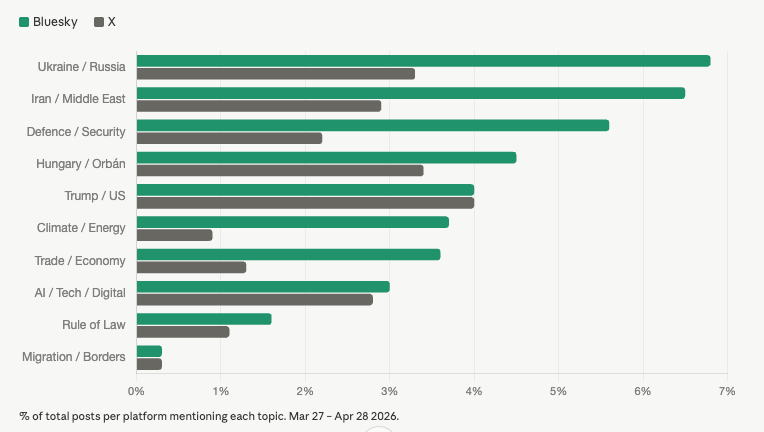
The topics are largely the same on both platforms — Ukraine, Trump, Orbán, Iran, defence. These are the unavoidable conversations of European political life and no MEP escapes them.
 
The difference is one of intensity. Bluesky carries a denser signal on geopolitical and long-term policy themes: Ukraine features in 6.8% of posts there versus 3.3% on X; defence and security at 5.6% vs 2.2%; climate and energy at 3.7% vs just 0.9%. The one topic that lands equally on both channels? Trump — 4.0% across the board. Transatlantic anxiety, it seems, is truly platform-agnostic.
 
The takeaway is straightforward: X gives you volume and linguistic breadth, Bluesky gives you a more concentrated policy signal. Monitoring just one means missing part of the picture.


Is Bluesky’s presence significant?

Yes — and significantly underestimated by those who still treat X as the only game in town. Having 283 MEPs and Commissioners actively posting on Bluesky means that roughly a third of the entire Parliament and Commission is generating public political content on a platform that most monitoring tools still ignore entirely. Issues raised there, positions announced there, and debates happening there are flying under the radar of traditional political intelligence.
That’s a blind spot — and a costly one for anyone whose job is to track EU policy narratives, stakeholder positions, or early signals of legislative intent.


What this means for EU affairs monitoring

At Disclosing Europe, we believe that following EU political conversation in 2026 means following it on both platforms. Our data infrastructure captures, processes, and contextualizes content from X and Bluesky simultaneously, giving our clients a complete picture of what elected representatives are actually saying — not just what appears in press releases.

This study is a glimpse into that capability. If understanding the full spectrum of EU political discourse matters to your organization, we’d love to show you more.

Share
0

Related posts

20 de April de 2026

What European Decision-Makers Are Really Talking About on Bluesky


Read more
15 de April de 2026

How MEPs and EU Commissioners Reacted Online to the Iran–US–Israel Conflict


Read more
8 de May de 2025

Limitations and challenges of AI in social media profile research


Read more
+34 629 360 849     info@sybaris.eu

Sybaris, with love from somewhere over the rainbow.

Sybaris EU 2021. Privacy policy
Certificado huella cero

Mad about nature and all-in for a sustainable future! We're doing our bit by planting and reforesting to make our planet greener.


The Middle Step ha sido beneficiaria del Fondo Europeo de Desarrollo Regional cuyo objetivo es mejorar el uso y la calidad de las tecnologías de la información y de las comunicaciones y el acceso a las mismas y gracias al que ha implantado la página web, para la mejora de competitividad y productividad de la empresa. La acción se realizó en 2021. Para ello ha contado con el apoyo del Programa TicCámaras de la Cámara de Comercio de Santiago de Compostela.” Una manera de hacer Europa

Camara de Comercio Santiago de Compostela